Drawing Kids' Faces Using Simple Geometric Shapes
28 de agosto de 2026
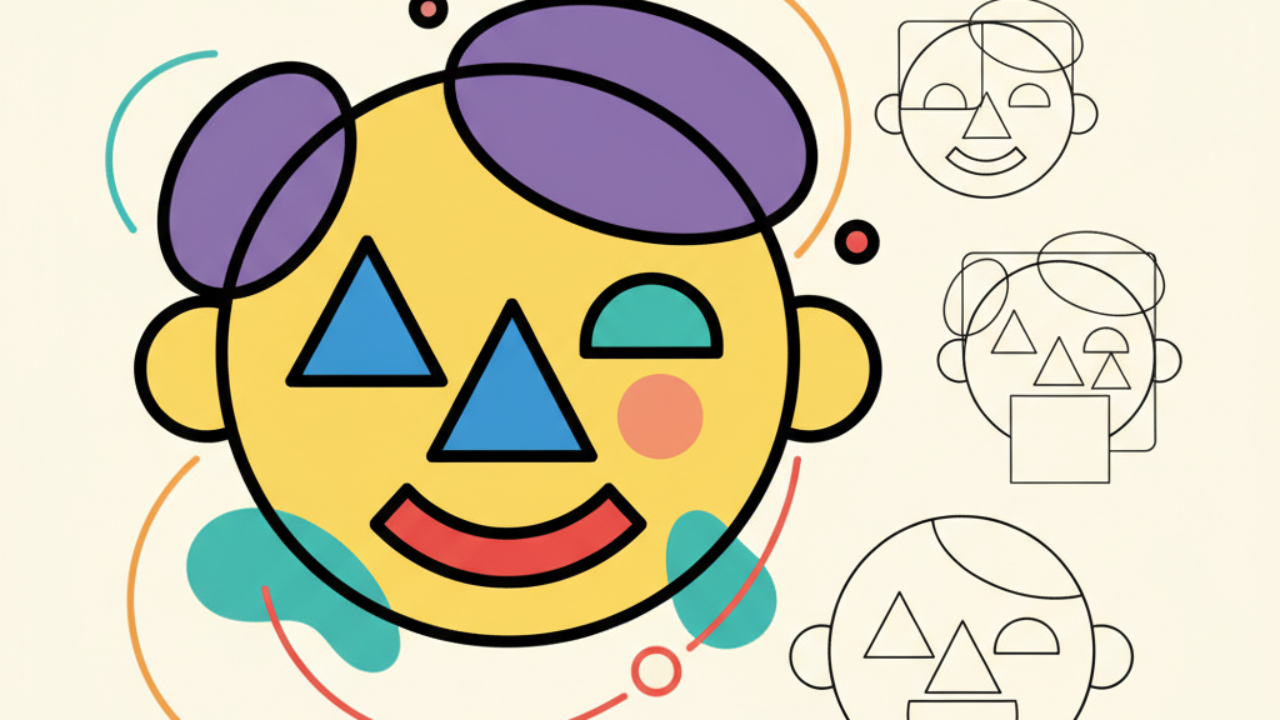
Learn how to create cute faces using basic geometric shapes! Check out our easy drawing tips and download free coloring pages for kids to print now. 🎨
The Foundation of Everything: The Power of Circles and Ovals
When we look at character coloring pages, the first thing we notice is the softness of the lines. For children's faces, the circle is the fundamental tool. Unlike adult faces, which have sharper angles and defined jawlines, kids have rounded features that convey innocence and cuteness. By using a circle as your base, you ensure the skull's proportions are accurate, making the process of printing for free and practicing your final art much easier.
The oval is the perfect variation for slightly longer faces or when a child is drawn from a profile view. Practicing these geometric shapes helps loosen your wrist and prepares you to handle more complex coloring sheets. When drawing a circle, try not to press too hard with your pencil; the idea is for this shape to serve as an invisible guide beneath your kid-friendly line art.
A pro tip is to divide that circle in half with a vertical and a horizontal line. This geometric "target" defines where the eyes, nose, and mouth will be positioned, ensuring your digital coloring book or physical sketches have symmetrical and visually pleasing characters for little artists.
Triangles and the Expressiveness of Chin and Nose
Although a child's face is predominantly round, the triangle plays a crucial role in defining small details. The nose, for example, can be simplified as a small isosceles triangle or just a subtle curve suggesting that shape. In cute drawings, the fewer complex anatomical details you use, the more charismatic the character becomes.
Triangles also help define the slope of the cheeks relative to the chin. If you trace an inverted triangle from the temples down to the tip of the chin, you'll maintain a solid facial structure. This is essential for anyone looking to create coloring activities that help develop spatial perception for those learning to draw from scratch.
Once you finish the geometric structure, you'll see the face gains a three-dimensionality that freehand lines rarely offer. This technique is widely used in AI-generated drawings to create consistent patterns, and you can replicate this manually to get professional results for your printable art.
Quick Tip: When drawing the nose triangle, place it exactly at the intersection of your initial circle's guide lines. This keeps the face from looking lopsided when it's time to add colors in your favorite online coloring tool.
Squares and Rectangles for Hair and Neck Structures
We often forget that hair also follows geometric shapes. For kids' faces, we can think of bangs as jagged rectangles and buns as small circles on top of the head. Using rectangular shapes helps add volume and weight, which is vital for those who enjoy educational drawings that teach about light and shadow.
A child's neck should be drawn as a short, wide rectangle. Avoid long, thin necks, which are characteristics of adults or elegantly stylized characters. At Desenhando e Colorindo, we focus on simplicity that allows kids of all ages to easily identify and fill in the spaces.
By combining rectangles with soft curves, you create a natural transition between the head and shoulders. This geometric base is the secret behind the best free printable coloring pages, as it provides clear boundaries for coloring, whether using colored pencils, crayons, or digital tools.
Why Practice with Geometry?
Using geometric shapes isn't just a drawing method; it's a way to train your brain to see the world in building blocks. This makes creating exclusive coloring pages easier and helps in memorizing human proportions. For parents and teachers, teaching this technique is an excellent way to introduce basic math concepts through art.
- Symmetry: Using geometric axes ensures both sides of the face are equal.
- Proportion: Helps you understand that eyes belong in the middle of the head, not at the top.
- Speed: With basic shapes, you can sketch a character in seconds.
- Easier Coloring: Well-defined shapes create better areas for filling in color.
Furthermore, by mastering geometry, you can adapt any drawing to different styles, from the simplest cartoon to detailed illustrations for kids' coloring. It's the first step for anyone wanting to turn a hobby into a solid technical skill.
The Importance of Eyes: Big Circles for Maximum Cuteness
In children's faces, eyes are generally larger and lower on the face than in adults. Using two large circles is the golden rule. The more space you give to the iris and pupil, the more expressive your free printable drawing will be. The distance between the two circles should ideally be the width of an imaginary third circle.
Inside these circles, you can add small white ovals to represent eye highlights. This detail makes all the difference in children's line art, giving the character life and soul. Remember that practicing these gaze details is a great way to spend time creatively indoors.
Many beginner artists make the mistake of drawing eyes too small or too high on the forehead. By using the geometry of the divided central circle, you’ll always know the exact spot to place these spheres, ensuring your homemade coloring book looks professional.
Step-by-Step to Create Your Own Coloring Page
Now that you understand the shapes, let's structure the process to create art ready for Desenhando e Colorindo. The goal is to create something clean, with well-defined lines that won't confuse a child while they paint.
- Step 1: Draw a light circle for the skull.
- Step 2: Add a centered cross to mark symmetry.
- Step 3: Draw two large circles for the eyes on the horizontal line.
- Step 4: Add a small triangle for the nose and a soft curve for the mouth.
- Step 5: Define the face outline using the original circle as a base, rounding out the cheeks.
- Step 6: Erase the guide lines and darken the final stroke to create crisp line art.
This method is foolproof. Once the drawing is ready, you can scan it or simply start coloring. The clarity of geometric shapes makes color usage much more intuitive, especially in educational drawings where the focus is on motor skills.
Tips for Quality Printing and Coloring
To get the best result from your free printable coloring pages, choosing the right paper and printer settings is key. Geometric drawings often lose detail if the print is too light or the paper is too thin, causing ink bleed.
We recommend using paper heavier than 20lb (90g) so kids can use markers without staining the back. If using watercolors, look for specific 180g+ paper. The drawing's geometry helps define shadow areas, so take advantage of the round cheek shapes to teach smooth gradients with colored pencils.
Printing Tip: Always select "Grayscale" and "High Quality" in your printer settings. This ensures your line art stays sharp and black, making it easier for whoever is coloring.
The Future of Drawing: AI and Human Creativity
Nowadays, AI-generated drawings are revolutionizing how we create coloring activities. At Desenhando e Colorindo, we use these tools to generate perfect geometric bases that serve as inspiration for new artists. AI can understand these circle and triangle proportions instantly, delivering ready-to-print images in seconds.
However, manual practice based on geometry remains essential. It develops visual perception that no machine can completely replace. By merging the technology of AI coloring pages with traditional techniques, you expand your creative possibilities infinitely.
Frequently Asked Questions
Why use geometric shapes to draw faces?
Geometric shapes serve as a structural guide that ensures proportion and symmetry. They make it easier to visualize the drawing before adding details, making the coloring page creation process much simpler and more effective.
What is the best geometric shape for a child's face?
The circle and the oval are the best shapes for representing children's faces, as they suggest softness, youth, and cuteness—essential traits in cute drawings and kids' line art.
How can I turn my drawing into a coloring page?
After making the geometric sketch, trace the main lines with a sharp black pen and erase the pencil marks. Then, just scan or photograph the drawing to have your own printable art.
Can I use these techniques for online coloring?
Absolutely! Geometric shapes help define color layers in digital painting software. Understanding the face's structure makes it easier to use paint buckets and apply shadows in online coloring tools.
Constant practice using geometric shapes is the secret to evolving in the art of drawing. Now that you know these techniques, how about getting to work? Explore our vast collection of free printable coloring pages at Desenhando e Colorindo and apply what you've learned. Choose your favorite character, grab your pencils, and start creating amazing art today!
Escrito e revisado por Armando Amaro
Fundador do Desenhando e Colorindo. Todo artigo passa por curadoria e revisão humana antes de ser publicado.